
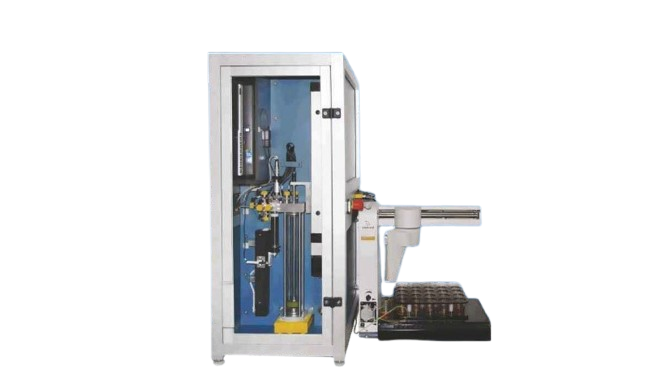
Merel GE-567:
Fully automated gas extraction unit based on Multi-cycle Mercury free Vacuum extraction method coupled with Agilent GC system by a pump and tube according to international standards IEC 60567 and ASTM D-361. Mercury free Toepler principle produces more extracted gases, because extraction is made in high vacuum. Transfer of gas from the pump to the GC is is done with very small dead volume, which can be measured and used to apply corrections. If the content of gas is too low to inject into GC, it can be automatically diluted with air or argon.
System components :
Dissolved Gas Analysis (DGA) is a widely used technique to estimate the condition of oil- immersed transformers. Incipient faults within the transformer may be detected by analyzing the gases which are dissolved in the transformer-oil.
DGA is a diagnostic tool for detecting and evaluating of incipient faults in oil-immersed transformers. In this context, a fault is defined as a process that causes abnormal dissipation of energy within the transformer. When a fault occurs in the transformer, the insulation system will undergo chemical
degradation which leads to production of various gasses that dissolve in the oil. These gases are often referred to as key gases, and their concentrations can be related to different types of faults in the transformer by various interpreting methods.
The gases that are of interest for the DGA analysis are the following:
H2 – hydrogen
CH4 – methane
C2H4 – ethylene
C2H6 – ethane
C2H2 – acetylene
C3H6 – propene
C3H8 – propane
CO – carbon monoxide
CO2 – carbon dioxide
O2 – oxygen
N2 – nitrogen
TCG – total combustible gas content (H2, CH4, C2H4, C2H6, C2H2, CO, C3H6, C3H8)
Operating principle :
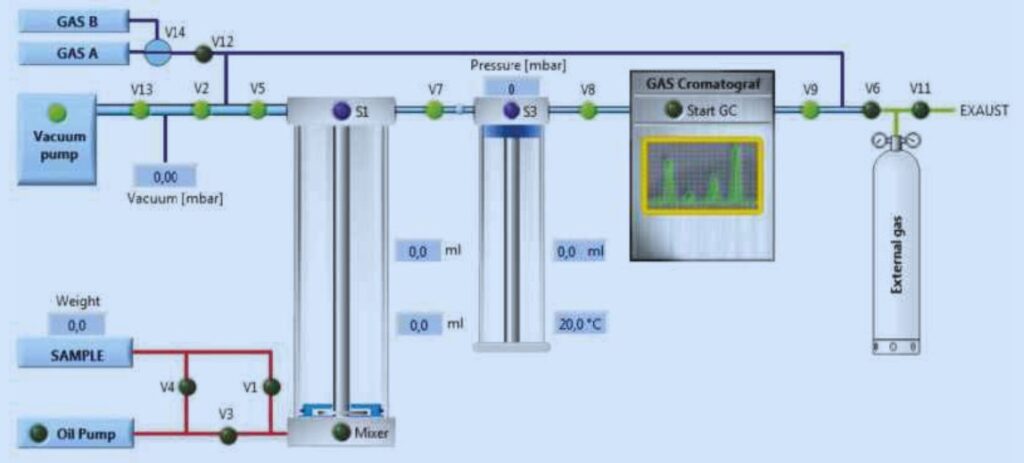
DGA procedure :
Today DGA technique is best performed in laboratory since it requires measuring instruments with high accuracy. One could summarize the DGA procedure in the following four steps:
Sampling of transformer oil:
The oil samples should preferably be taken in the moving oil so that the gases generated are conveniently and rapidly transported from the point of generation to the sampling point. Suitable locations are valves in the cooler/radiator circuit. It is not always possible to take samples at these locations because of design limitations. Other places to draw samples from are cover, bottom valve, conservator and the Buchholz relay. In addition, it is very important that the sampling is made in such a way that the contamination of the sampling vessel is held at a minimum and that gases are not lost during sampling or transportation to the laboratory.
Extraction of the gases from the oil:
The removal of the gases from the oil can be accomplished by various methods:
-partial degassing (single-cycle vacuum extraction)
-total degassing (multi-cycle vacuum extraction)
-stripping by flushing the oil with another gas.
by the headspace technique in which gases are ”equalized” between a free gas volume and the oil volume.
TOGA analyzer Merel GE-567 uses total degassing method. The gas extractor is a fully automated vacuum degassing unit for extracting gas from transformer oil with multi-cycle Mercury free Vacuum extraction according to international standards IEC 60567 in ASTM D-361.
Analysis of the extracted gas mixture in a gas chromatography, GC:
After extraction the extracted gas mixture is fed into adsorption columns in a GC where the different gases are adsorbed and separated to various degrees and consequently reach the detector at different points in time. In this way the gas mixture is separated into individual chemical compounds, identified and their concentrations in volume gas STP/volume oil is calculated and expressed in ppm. (STP = standard temperature and pressure).
Interpretation of data:
When the different gases in the oil sample have been identified and quantified quantified, all that remains is to interpret the results. Evaluation of the condition of the transformer oil is made on whether the amount of dissolved gases can be considered as normal/acceptable or not. In the case where there is an abnormal gas production it is necessary to try figuring out the origin of the gas production, i.e finding possible fault causes.
Key attributes :
The Merel Collaborative Laboratory System is versatile, supporting a wide range of applications in pharmaceutical, chemical, and related fields. From routine analytical tasks to more complex experimental setups, our system provides a robust platform for innovation and discovery.
Application case studies :
The system fully complies with norm IEC 60567.
- Sample volume 10 to 250 mL.
- The possibility of measuring the low levels of gas under 0.5 mL / L.
- Free-setting of extraction parameters. (Define number of strokes and duration of each).
- “Dead volume” could be measured for diagnostic and (or) volume correction.
- The piston pump diagnostic with injection of 10 mL of air to verify the tightness of the piston.
- Export measurements-value in EXCEL.
- View all operating parameters, including intermediate extraction with the announcement of the final result.
- The conversion of the normalized value of 1013.25 mbar and 20 °C.
- All phases in extractions could be done manually in steps.
- Calibration of the scale, pressure sensor, temperature sensor and vacuum sensor is included in the SW.
- Buchholz gas analysis.
- Analysis of the external gas (cylinder).
- Use and hardware software leading manufacturer in the field of measuring / control equipment (National Instruments).
- The user interface could be translated to the local language.
Technical information :
Auto-sampler
Oil sample volume
10 – 200 mL
No. of positions
20 @ 120 mL
Gas extractor
Type of transformer oils
new and used
Dual stage vacuum oil pump
ultimate pressure 2×10⁻³ mbar
Gas extraction cycles and times
set in software
Vacuum measurement/range
1.3 x 10⁻³ mbar – 1333 mbar
Oil sample measurement/accuracy
gravimetric / ± 0.05 mL
Gas volume measurement
precision glass burette/precision pressure sensor – T compensated
Gas volume measurement corrected
to standard atmosphere (1013.25 mbar / 20 °C)
Pressure sensor accuracy
± 0.05 % @ 1013 mbar / 10-40 °C
Pressure sensor and balance calibration
performed in software
Extracted Gas volume range
1 mL/L – 200 mL/L
Extracted Gas volume accuracy
±10% @ 1 mL/L – 20 mL/L, ± 2% @ 20 mL/L – 200mL/L
Gas transfer and analyses
Standard TGA GC instrument (loop volume 0.25 – 1.0 mL)
Power input
115 – 240 VAC, 50 – 60 Hz
Power Input
950 W
Dimensions (WxHxD)
440 x 1040 x 620 mm
Weight
50 kg